
Previous Session Recap
Trading volume at PSX floor dropped by 32.03 million shares or 18.62% on DoD basis, whereas the benchmark KSE100 index opened at 37,519.57, posted a day high of 37,635.70 and a day low of 37,339.21 points during last trading session while session suspended at 37,381.95 with net change of -122.13 points and net trading volume of 95.32 million shares. Daily trading volume of KSE100 listed companies dropped by 39.59 million shares or 29.34% on DoD basis.
Foreign Investors remained in net buying positions of 3.05 million shares and net value of Foreign Inflow increased by 0.59 million US Dollars. Categorically, Foreign Individuals, and Overseas Pakistani remained in net selling positions of 0.01 and 0.25 million shares but Foreign Corporate investors remained in net buying positions of 3.31 million shares respectively. While on the other side Local Companies and Brokers remained in net selling positions of 15.35 and 0.32 million shares respectively but Local Individuals, Banks, Mutual Funds and Insurance companies remained in net buying positions of 8.03, 0.63, 3.11 and 0.68 million shares respectively.
Analytical Review
Asia relieved as China data point to recovery
Asian share markets swung higher on Wednesday as a raft of Chinese data easily beat expectations in a sign Beijing’s policy stimulus may finally be gaining traction in the world’s second-largest economy. Investors were hoping for better news from China and were not disappointed with first-quarter economic growth pipping forecast at 6.4 percent. More importantly industrial output surged 8.5 percent in March from a year earlier, blowing away forecasts of a 5.9 percent increase. Retail sales also pleased with a rise of 8.7 percent. Investors reacted immediately by buying the Australian dollar, often a liquid proxy for China plays, which pushed up 0.3 percent to a two-month top at $0.7206.
FPCCI for cut in rate of taxes on industry
Federation of Pakistan Chambers of Commerce and Industry (FPCCI) on Tuesday demanded the government gradually reduce the rate of general sales tax (GST) and taxes on corporate sector to revive the industry in the country. The FPCCI has recommended the government to consider its decision of devaluing the currency, which had resulted in inflation in the country and affecting the common people. The government should also give ten years tax exemptions instead of existing five years on establishing new industry in the country. FPCCI President Daroo Khan gave budget proposals in the National Assembly standing committee on Finance and Revenue yesterday. He also suggested that government should provide gas and electricity to the industries on subsidies rates to enhance the country’s exports. Similarly, the government should reduce the taxes on property while increasing rates from existing DC rates.
SBP injects Rs150b into money market
State Bank of Pakistan (SBP) on Tuesday injected Rs 150 billion into money market for three days as reverse repo purchase through its open market operation. Nine bids of Rs 191.2 bln were offered, of which five worth Rs 150 billion were accepted. The rate of return accepted was 10.83 percent per annum, an SBP press release said.
Pakistan’s economy to weigh on region’s growth: IMF official
Pakistan’s economy is projected to slow down significantly and weigh on the region’s aggregate growth rate, says Jihad Azour, director of the Middle East and Central Asia department at the International Monetary Fund. At a recent talk on the economic outlook for the Middle East, North Africa, Afghanistan, and Pakistan (MENAP) region, Azour argued that global economic headwinds were making policy efforts more urgent and challenging for MENAP. For oil importers in this region, growth is expected to ease to 3.6 per cent this, from 4.2pc in 2018, in part due to weaker global economic environment. Azour noted that in many oil-importing countries, rising debt levels were becoming a more urgent challenge for macroeconomic stability and high debt was also limiting fiscal space for critical investments in health, education, infrastructure, and social programmes.
Tax amnesty plan approval deferred amid reservations
The federal cabinet on Tuesday deferred the approval of the much-awaited tax amnesty scheme after some of the ministers opposed it, expressed their reservations and sought further clarification. To deliberate on the issue in detail, Prime Minister Imran Khan convened a special meeting of the cabinet on Wednesday. Inside sources told Dawn that some cabinet members objected to the 15 per cent tax rate proposed under the scheme and some raised questions about its effectiveness. Federal Minister for Communications Murad Saeed said he wanted to know the difference between the proposed scheme and the similar ones which had been launched by the previous government, according to the sources privy to the details of the cabinet meeting held at PM Office. Expressing his reservation over the 15pc rate, Minister for Water Resources Faisal Vawda called for its reduction to facilitate taxpayers, the sources said.
Asian share markets swung higher on Wednesday as a raft of Chinese data easily beat expectations in a sign Beijing’s policy stimulus may finally be gaining traction in the world’s second-largest economy. Investors were hoping for better news from China and were not disappointed with first-quarter economic growth pipping forecast at 6.4 percent. More importantly industrial output surged 8.5 percent in March from a year earlier, blowing away forecasts of a 5.9 percent increase. Retail sales also pleased with a rise of 8.7 percent. Investors reacted immediately by buying the Australian dollar, often a liquid proxy for China plays, which pushed up 0.3 percent to a two-month top at $0.7206.
Federation of Pakistan Chambers of Commerce and Industry (FPCCI) on Tuesday demanded the government gradually reduce the rate of general sales tax (GST) and taxes on corporate sector to revive the industry in the country. The FPCCI has recommended the government to consider its decision of devaluing the currency, which had resulted in inflation in the country and affecting the common people. The government should also give ten years tax exemptions instead of existing five years on establishing new industry in the country. FPCCI President Daroo Khan gave budget proposals in the National Assembly standing committee on Finance and Revenue yesterday. He also suggested that government should provide gas and electricity to the industries on subsidies rates to enhance the country’s exports. Similarly, the government should reduce the taxes on property while increasing rates from existing DC rates.
State Bank of Pakistan (SBP) on Tuesday injected Rs 150 billion into money market for three days as reverse repo purchase through its open market operation. Nine bids of Rs 191.2 bln were offered, of which five worth Rs 150 billion were accepted. The rate of return accepted was 10.83 percent per annum, an SBP press release said.
Pakistan’s economy is projected to slow down significantly and weigh on the region’s aggregate growth rate, says Jihad Azour, director of the Middle East and Central Asia department at the International Monetary Fund. At a recent talk on the economic outlook for the Middle East, North Africa, Afghanistan, and Pakistan (MENAP) region, Azour argued that global economic headwinds were making policy efforts more urgent and challenging for MENAP. For oil importers in this region, growth is expected to ease to 3.6 per cent this, from 4.2pc in 2018, in part due to weaker global economic environment. Azour noted that in many oil-importing countries, rising debt levels were becoming a more urgent challenge for macroeconomic stability and high debt was also limiting fiscal space for critical investments in health, education, infrastructure, and social programmes.
The federal cabinet on Tuesday deferred the approval of the much-awaited tax amnesty scheme after some of the ministers opposed it, expressed their reservations and sought further clarification. To deliberate on the issue in detail, Prime Minister Imran Khan convened a special meeting of the cabinet on Wednesday. Inside sources told Dawn that some cabinet members objected to the 15 per cent tax rate proposed under the scheme and some raised questions about its effectiveness. Federal Minister for Communications Murad Saeed said he wanted to know the difference between the proposed scheme and the similar ones which had been launched by the previous government, according to the sources privy to the details of the cabinet meeting held at PM Office. Expressing his reservation over the 15pc rate, Minister for Water Resources Faisal Vawda called for its reduction to facilitate taxpayers, the sources said.
PSO, EFOODS, ENGRO, DGKC and MLCF would try to lead the negative momentum on intraday basis, while SNGP, PAEL and DOL would try to support bullish sentiment.
Technical Analysis
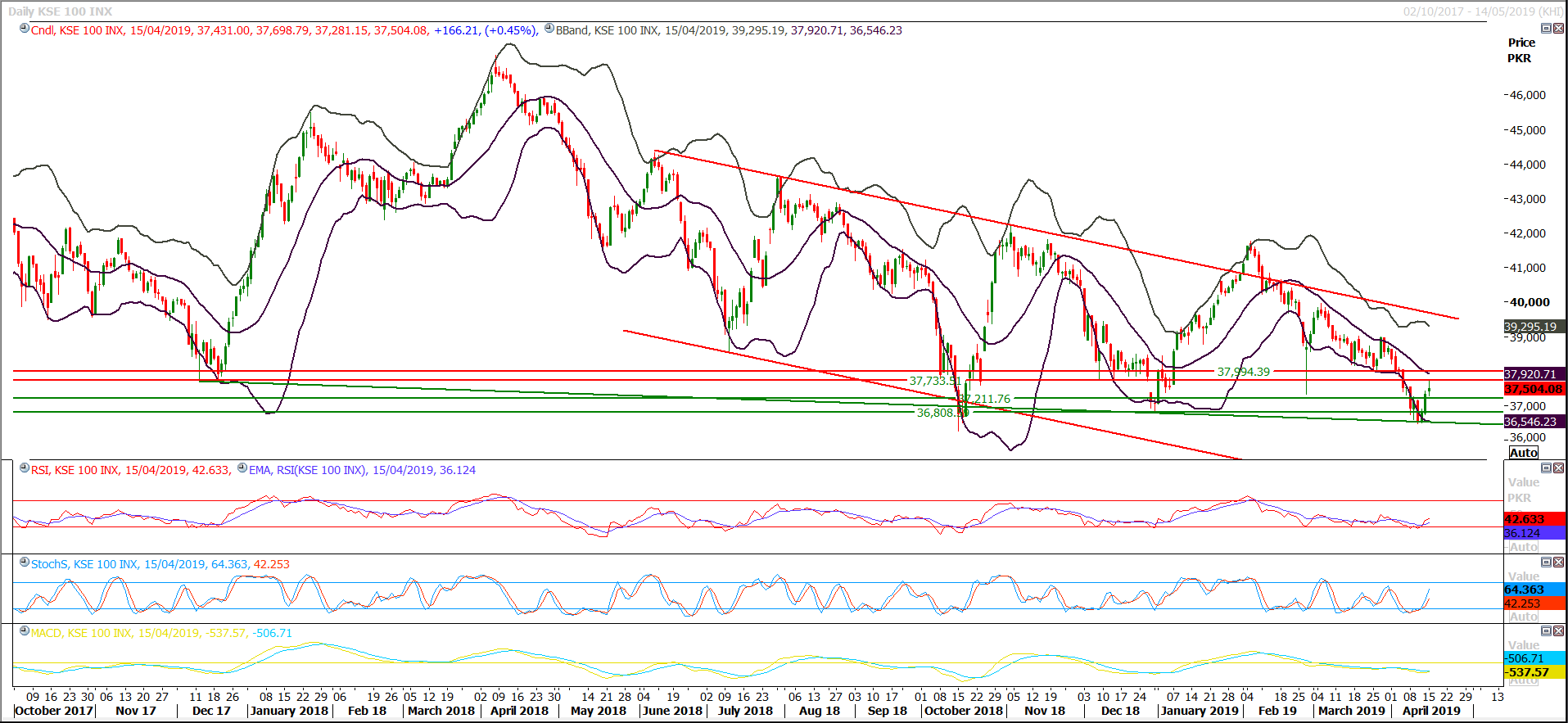
The Benchmark KSE100 Index have bounced back after getting resistance from a horizontal resistance at 37,700 points during last trading session and now it’s expected that index would remain under pressure during first half because hourly momentum indicators have changed their direction to bearish side and a doji have been formatted on daily chart which would try to vanish positive momentum created by a morning star previously. As chance of occurrence of an evening star on daily chart has become evident in response to previous morning star therefore it’s recommended to stay cautious while trading during current trading session and it’s recommended to post strict stop loss on long positions.
 To Open picture in original resolution right click image and then click open image in a new tab
0 Comments
No comments yet. Be the first to comment!
Please log in to leave a comment.