
Previous Session Recap
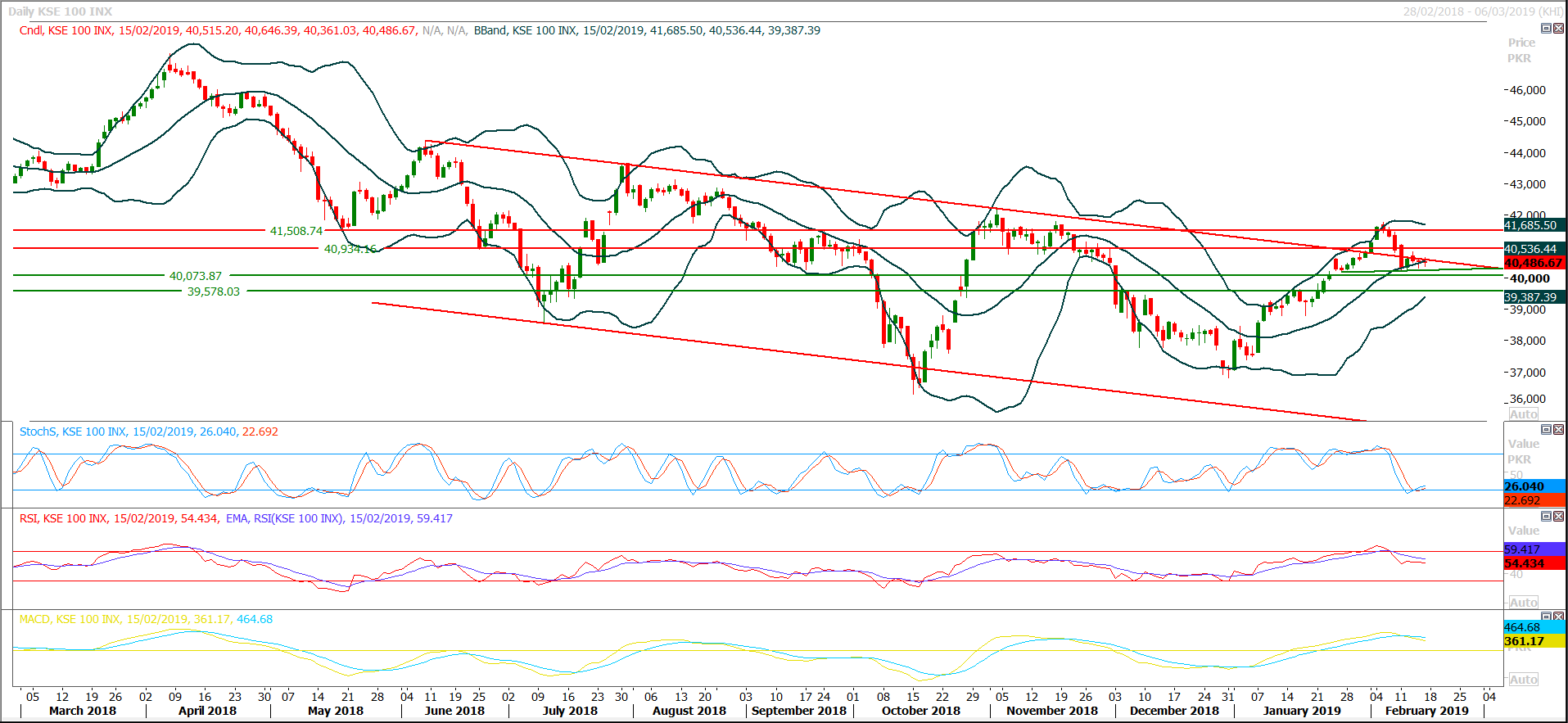
Trading volume at PSX floor dropped by 30.62 million shares or 24.77% on DoD basis, whereas the benchmark KSE100 index opened at 40,515.20, posted a day high of 40,646.39 and a day low of 40,361.03 points during last trading session while session suspended at 40,486.67 with net change of -20.31 points and net trading volume of 46.64 million shares. Daily trading volume of KSE100 listed companies dropped by 11.66 million shares or 20.0% on DoD basis.
Foreign Investors remained in net buying positions of 2.16 million shares and net value of Foreign Inflow increased by 1.66 million US Dollars. Categorically, Foreign Corporate and Overseas Pakistani remained in net buying positions of 1.82 and 0.51 million shares but and Foreign Individuals investors remained in net selling positions of 0.16 million shares. While on the other side Local Individuals, Local Companies, Banks and NBFCs remained in net buying positions of 2.55, 1.06, 2.63 and 0.60 million shares respectively but Mutual Fund, Brokers and Insurance Companies remained in net selling positions of 5.17, 0.96 and 1.52 million shares.
Analytical Review
Asia bulls dare to hope on trade talks, stimulus
Asian share markets bounced broadly on Monday as investors dared to hope for both progress at Sino-U.S. trade talks in Washington this week and more policy stimulus from major central banks. MSCI’s broadest index of Asia-Pacific shares outside Japan rose 1 percent, recovering from a sharp fall last Friday. Japan’s Nikkei climbed 1.8 percent to its highest level of the year so far, while Australia’s main index rose 0.7 percent. Shanghai blue chips bounced 1.6 percent. But E-Mini futures for the S&P 500 were flat as trade was thinned by a holiday in U.S. markets.
FATF group to review Pakistan’s performance today
A four-member Pakistani delegation will be witnessing on Monday a review in Paris of its performance by an expert group of the Financial Action Task Force (FATF) on its compliance with global guidelines against terror financing and money laundering. The Asia-Pacific Group (APG), an associate firm of the Paris-based FATF, will present Pakistan’s report and responses to five specific queries it was asked last month to the International Country Risk Guide (ICRG) — Political Risk Services (PRS) group. The FATF plenary and its various group meetings will be held from Feb 18 to 22.
Pakistan facing funding challenges in reducing disaster risk: report
Pakistan continues to face funding challenges for disaster risk reduction and disaster response, and the heavily decentralised approach to disaster relief fund is complicating challenges in enhancing disaster relief management, says a new report of the Asian Development Fund. The report titled ‘Diagnostics Assessment of the Disaster Risk Financing (DRF) in Pakistan’ suggests that an effective disaster relief financing strategy should be developed based on detailed knowledge of the country’s disaster risk. According to the report, while some district and city-specific multi-hazard vulnerability and risk assessments have been conducted, no comprehensive stochastic assessment of disaster risk is now available for the entire country.
Oil imports surge to $8.7bn in seven months
The country’s oil import bill soared 10 per cent year-on-year to $8.68 billion during the first seven months of this fiscal year, according to data released by the Pakistan Bureau of Statistics (PBS). Contrary to this, barring agriculture products and textile group, imports from almost all of the groups including machinery-related items contracted during the period under review. The data for July-January period suggests trade deficit is on a declining trend; as a result, the overall import bill during the seven-month period fell by 5.17pc YoY to $32.49bn. Consequently, the trade deficit fell by 9.66pc YoY to $19.2bn YoY during the same period. Product-wise data shows that petroleum group imports saw a double digit growth of 10pc, reaching $8.68bn in July-Jan as against $7.89bn over the corresponding months last year, with the largest surge coming from crude oil, up 27.15pc.
Economy still in muddy waters
Pakistan’s external debt and liabilities increased to a record $99.1 billion by the end of December 2018. The country’s external debt and liabilities surged by $3.77 billion to $99.1 in first six months (July to December) of the ongoing fiscal year, according to the SBP’s latest data. The country’s external debt and liabilities were at $95.34 billion at the end of previous year. Pakistan’s external debt is rapidly increasing as successive governments heavily depended on securing foreign debts instead of increasing exports. The foreign exchange reserves stand at $8.21 billion, enough to cover only one and half months imports.
Asian share markets bounced broadly on Monday as investors dared to hope for both progress at Sino-U.S. trade talks in Washington this week and more policy stimulus from major central banks. MSCI’s broadest index of Asia-Pacific shares outside Japan rose 1 percent, recovering from a sharp fall last Friday. Japan’s Nikkei climbed 1.8 percent to its highest level of the year so far, while Australia’s main index rose 0.7 percent. Shanghai blue chips bounced 1.6 percent. But E-Mini futures for the S&P 500 were flat as trade was thinned by a holiday in U.S. markets.
A four-member Pakistani delegation will be witnessing on Monday a review in Paris of its performance by an expert group of the Financial Action Task Force (FATF) on its compliance with global guidelines against terror financing and money laundering. The Asia-Pacific Group (APG), an associate firm of the Paris-based FATF, will present Pakistan’s report and responses to five specific queries it was asked last month to the International Country Risk Guide (ICRG) — Political Risk Services (PRS) group. The FATF plenary and its various group meetings will be held from Feb 18 to 22.
Pakistan continues to face funding challenges for disaster risk reduction and disaster response, and the heavily decentralised approach to disaster relief fund is complicating challenges in enhancing disaster relief management, says a new report of the Asian Development Fund. The report titled ‘Diagnostics Assessment of the Disaster Risk Financing (DRF) in Pakistan’ suggests that an effective disaster relief financing strategy should be developed based on detailed knowledge of the country’s disaster risk. According to the report, while some district and city-specific multi-hazard vulnerability and risk assessments have been conducted, no comprehensive stochastic assessment of disaster risk is now available for the entire country.
The country’s oil import bill soared 10 per cent year-on-year to $8.68 billion during the first seven months of this fiscal year, according to data released by the Pakistan Bureau of Statistics (PBS). Contrary to this, barring agriculture products and textile group, imports from almost all of the groups including machinery-related items contracted during the period under review. The data for July-January period suggests trade deficit is on a declining trend; as a result, the overall import bill during the seven-month period fell by 5.17pc YoY to $32.49bn. Consequently, the trade deficit fell by 9.66pc YoY to $19.2bn YoY during the same period. Product-wise data shows that petroleum group imports saw a double digit growth of 10pc, reaching $8.68bn in July-Jan as against $7.89bn over the corresponding months last year, with the largest surge coming from crude oil, up 27.15pc.
Pakistan’s external debt and liabilities increased to a record $99.1 billion by the end of December 2018. The country’s external debt and liabilities surged by $3.77 billion to $99.1 in first six months (July to December) of the ongoing fiscal year, according to the SBP’s latest data. The country’s external debt and liabilities were at $95.34 billion at the end of previous year. Pakistan’s external debt is rapidly increasing as successive governments heavily depended on securing foreign debts instead of increasing exports. The foreign exchange reserves stand at $8.21 billion, enough to cover only one and half months imports.
Market is expected to remain volatile during current trading session therefore it's recommended to stay cautious while trading
Technical Analysis
The Benchmark KSE100 index is being supported by a rising trend line along with a horizontal supportive region since last week and it’s trying to penetrate its bearish trend channel in upward direction. Daily momentum indicators are trying to generate bullish crossovers and MAORSI already have succeeded in doing so while stochastic is on its way to complete that crossover. As of now it’s recommended to stay cautious buying on dip would be recommended for intraday trading because index would try to cheat its weekly formation of bearish sentiment and it’s expected that index would remain bullish during current trading session. For current trading session index would face resistances at 40,860 and 41,200 points while supportive regions are standing at 40,000 and 39,800 points.
 To Open picture in original resolution right click image and then click open image in a new tab
0 Comments
No comments yet. Be the first to comment!
Please log in to leave a comment.