
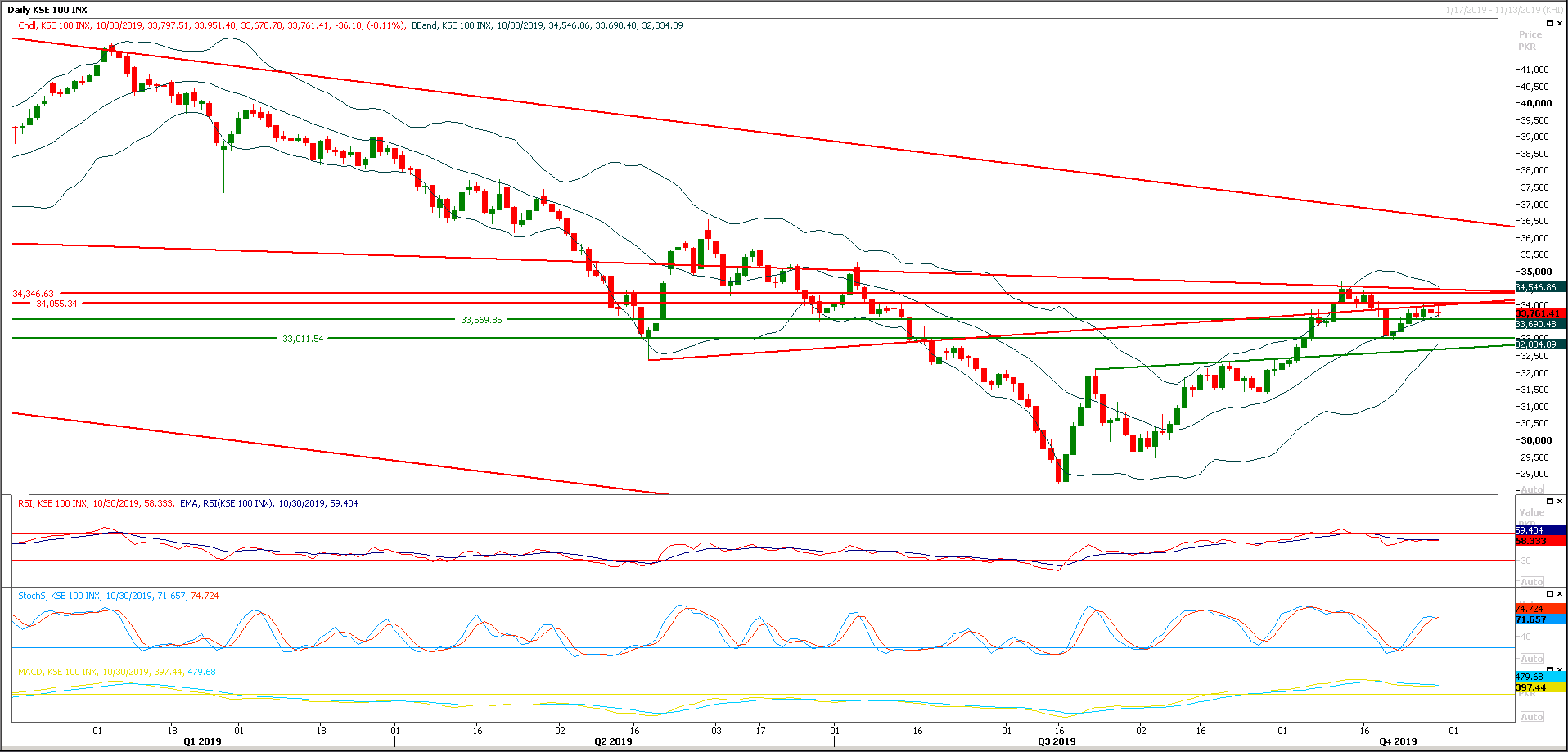
Previous Session Recap
Trading volume at PSX floor dropped by 95.12 million shares or 42.26% on DoD basis, whereas the benchmark KSE100 index opened at 33,797.51, posted a day high of 33,951.48 and a day low of 33,670.70 points during last trading session while session suspended at 33,761.41 points with net change of -36.1 points and net trading volume of 78.70 million shares. Daily trading volume of KSE100 listed companies dropped by 56.40 million shares or 41.74% on DoD basis.
Foreign Investors remained in net selling positions of 1.81 million shares but net value of Foreign Inflow increased by 0.31 million US Dollars. Categorically, Foreign Corporate remained in net selling positions of 2.18 million shares but Foreign Individual and Overseas Pakistanis investors remained in net buying positions of 0.02 and 0.35 million shares. While on the other side Local Individuals, Banks and Insurance Companies remained in net selling positions of 1.14, 4.71 and 1.43 million shares respectively but Local Companies, NBFCs, Mutual Fund and Brokers remained in net buying positions of 6.01, 0.13, 2.20 and 0.87 million shares respectively.
Analytical Review
U.S. Fed cuts interest rates, signals it is on hold
The Federal Reserve on Wednesday cut interest rates for the third time this year to help sustain U.S. growth despite a slowdown in other parts of the world, but signaled there would be no further reductions unless the economy takes a turn for the worse. “We believe that monetary policy is in a good place,” Fed Chair Jerome Powell said in a news conference after the U.S. central bank announced its decision to cut its key overnight lending rate by a quarter of a percentage point to a target range of between 1.50% and 1.75%. “We took this step to help keep the economy strong in the face of global developments and to provide some insurance against ongoing risks,” he said. “We see the current stance of monetary policy as likely to remain appropriate as long as incoming information about the economy remains broadly consistent with our outlook.”
Ogra proposes slight increase in petrol, HSD prices
The government is likely to keep the prices of petroleum products largely unchanged for November as the Oil and Gas Regulatory Authority (Ogra) has worked out minor adjustments in the costs of various imported products. A senior official at the ministry of energy said that Ogra had worked out an increase of Re1 and 27 paisa in the prices of every litre of petrol and high speed diesel (HSD), respectively. On the other hand, it proposed a reduction of Rs2.39 and Rs6.56 respectively in the prices of every litre of kerosene and light diesel oil (LDO). According to him, the government will be losing only about Rs650 million if it keeps the prices largely unchanged for next month, but will earn a lot of goodwill at a time when opposition parties are holding big protest rallies. The official said a decision in this regard would be announced on Thursday (today) by the finance division after the approval of prime minister.
Pakistan wants IMF to separate FATF from programme
Pakistan has asked the International Monetary Fund (IMF) to relax conditionalities under the $6 billion Extended Fund Facility (EFF) relating to the Financial Action Task Force (FATF) and issuance of sovereign guarantees to help raise over $4bn from domestic and international markets. Pakistan has budgeted about $3bn bonds (about Rs450bn) — Islamic Sukuk and Eurobond — to be launched in the international capital markets during the current fiscal year to meet targets under the EFF for foreign inflows. Separately, the government has planned to raise about Rs200bn from domestic Islamic banks for the power sector to scale down circular debt. “We are dying to complete these transactions at the earliest,” a senior official told Dawn, adding that the capital market conditions were never as conducive as at present. He said the return on bonds had plummeted to almost zero in the international capital markets and investors were finding it hard to secure profits on secured papers. “This provides an ideal opportunity for Pakistan to tap international capital markets to secure sovereign bonds at a minimal interest rate,” the official said.
Traders end countrywide strike after reaching agreement with govt
The business community on Wednesday called off the countrywide shutter-down strike after reaching an eleven-point agreement with the government. The strike, which started on Tuesday, was held against the imposition of taxes, and presenting a CNIC copy for buying and selling goods up to Rs50,000. Adviser to the Prime Minister on Finance Dr Abdul Hafeez Sheikh, flanked by Federal Board of Revenue (FBR) Chairman Shabbar Zaidi and PTI stalwart Jahangir Tareen, announced the agreement at a press conference in Islamabad.
ECC approves release of 650,000 tonnes of wheat to KP, Sindh and Balochistan
The Economic Coordination Committee (ECC) of the Cabinet on Wednesday has approved to release 650,000 tonnes of wheat from PASSCO stocks to the provincial governments of Khyber Pakhtunkhwa (KP), Sindh and Balochistan to ease out the demand and supply equilibrium in the local market. The ECC, which met under the chair of Adviser to Prime Minister on Finance and Revenue Abdul Hafeez Shaikh, has discussed wheat situation in the country, particularly the rising trend in wheat prices. The ECC has approved a proposal by the Ministry of National Food Security and Research for release of 300,000 tonnes each to governments of Khyber Pakhtunkhwa and Sindh and 50,000 tonnes to the government of Balochistan. The ECC also approved an amount of Rs2.745 billion to be paid as PASSCO incidental charges at the ratio of 50:50 to be equally shared by the federal and respective provincial governments.
The Federal Reserve on Wednesday cut interest rates for the third time this year to help sustain U.S. growth despite a slowdown in other parts of the world, but signaled there would be no further reductions unless the economy takes a turn for the worse. “We believe that monetary policy is in a good place,” Fed Chair Jerome Powell said in a news conference after the U.S. central bank announced its decision to cut its key overnight lending rate by a quarter of a percentage point to a target range of between 1.50% and 1.75%. “We took this step to help keep the economy strong in the face of global developments and to provide some insurance against ongoing risks,” he said. “We see the current stance of monetary policy as likely to remain appropriate as long as incoming information about the economy remains broadly consistent with our outlook.”
The government is likely to keep the prices of petroleum products largely unchanged for November as the Oil and Gas Regulatory Authority (Ogra) has worked out minor adjustments in the costs of various imported products. A senior official at the ministry of energy said that Ogra had worked out an increase of Re1 and 27 paisa in the prices of every litre of petrol and high speed diesel (HSD), respectively. On the other hand, it proposed a reduction of Rs2.39 and Rs6.56 respectively in the prices of every litre of kerosene and light diesel oil (LDO). According to him, the government will be losing only about Rs650 million if it keeps the prices largely unchanged for next month, but will earn a lot of goodwill at a time when opposition parties are holding big protest rallies. The official said a decision in this regard would be announced on Thursday (today) by the finance division after the approval of prime minister.
Pakistan has asked the International Monetary Fund (IMF) to relax conditionalities under the $6 billion Extended Fund Facility (EFF) relating to the Financial Action Task Force (FATF) and issuance of sovereign guarantees to help raise over $4bn from domestic and international markets. Pakistan has budgeted about $3bn bonds (about Rs450bn) — Islamic Sukuk and Eurobond — to be launched in the international capital markets during the current fiscal year to meet targets under the EFF for foreign inflows. Separately, the government has planned to raise about Rs200bn from domestic Islamic banks for the power sector to scale down circular debt. “We are dying to complete these transactions at the earliest,” a senior official told Dawn, adding that the capital market conditions were never as conducive as at present. He said the return on bonds had plummeted to almost zero in the international capital markets and investors were finding it hard to secure profits on secured papers. “This provides an ideal opportunity for Pakistan to tap international capital markets to secure sovereign bonds at a minimal interest rate,” the official said.
The business community on Wednesday called off the countrywide shutter-down strike after reaching an eleven-point agreement with the government. The strike, which started on Tuesday, was held against the imposition of taxes, and presenting a CNIC copy for buying and selling goods up to Rs50,000. Adviser to the Prime Minister on Finance Dr Abdul Hafeez Sheikh, flanked by Federal Board of Revenue (FBR) Chairman Shabbar Zaidi and PTI stalwart Jahangir Tareen, announced the agreement at a press conference in Islamabad.
The Economic Coordination Committee (ECC) of the Cabinet on Wednesday has approved to release 650,000 tonnes of wheat from PASSCO stocks to the provincial governments of Khyber Pakhtunkhwa (KP), Sindh and Balochistan to ease out the demand and supply equilibrium in the local market. The ECC, which met under the chair of Adviser to Prime Minister on Finance and Revenue Abdul Hafeez Shaikh, has discussed wheat situation in the country, particularly the rising trend in wheat prices. The ECC has approved a proposal by the Ministry of National Food Security and Research for release of 300,000 tonnes each to governments of Khyber Pakhtunkhwa and Sindh and 50,000 tonnes to the government of Balochistan. The ECC also approved an amount of Rs2.745 billion to be paid as PASSCO incidental charges at the ratio of 50:50 to be equally shared by the federal and respective provincial governments.
Market is expected to remain volatile during current trading session.
Technical Analysis
Daily momentum indicators are trying to change their direction towards bearish side and it's expected that the Benchmark KSE100 index would remain under pressure until index would not succeed in penetration above 34,200 points. As of now index is being capped by a strong resistant trend line along with a horizontal resistant region therefore it's recommended to start selling on strength with strict stop loss of 34,200 points. Index would try to target 33,500 and then 33,330 points if it would succeed in maintain below its major resistant trend line on daily chart.

To Open picture in original resolution right click image and then click open image in a new tab
0 Comments
No comments yet. Be the first to comment!
Please log in to leave a comment.