
Previous Session Recap
Trading volume at PSX floor dropped by 82.44 million shares or 50.31% on DoD basis, whereas the benchmark KSE100 index opened at 39,718.18, posted a day high of 39,845.59 and a day low of 39,494.88 points during last trading session while session suspended at 39,568.10 with net change of -120.41 points and net trading volume of 61.61 million shares. Daily trading volume of KSE100 listed companies dropped by 65.05 million shares or 51.5% on DoD basis.
Foreign Investors remained in net selling positions of 1.92 million shares and net value of Foreign Inflow dropped by 0.69 million US Dollars. Categorically, Foreign Individuals, Corporate and Overseas Pakistani Investors remained in net selling positions of 0.03, 0.77 and 1.11 million shares respectively. While on the other side Local Individuals, Banks and NBFCs remained in net buying positions of 4.83, 0.40 and 2.89 million shares but Local Companies, Mutual Fund, Brokers and Insurance Companies remained in net selling positions of 0.27, 2.91, 1.30 and 1.83 million shares respectively.
Analytical Review
Asia shares sluggish as global growth concerns return
Asian shares rose marginally in early trade on Thursday, with caution prevailing as investors awaited some kind of resolution to Sino-U.S. trade negotiations, while the euro remained under pressure ahead of the European Central Bank meeting. Japan’s Nikkei average fell 0.6 percent, while Australian shares added 0.2 percent. MSCI’s broadest index of Asia-Pacific shares outside Japan rose 0.1 percent in early trade. It was not far from its five-month high marked last week and was up 10.4 percent year-to-date.
Govt plans to privatise 48 PSEs
The PTI led government has planned to privatise 48 public sector entities (PSEs) including loss-making Pakistan International Airlines (PIA) and Pakistan Steel Mills (PSM) during its five years constitutional tenure. Senior officials of the Privatization Commission have informed the National Assembly’s standing committee on privatisation about the privatization programme of the incumbent government. Secretary Privatization Commission Rizwan Malik briefed the committee that government has decided to privatize 48 public sector entities (PSEs) during its five years tenure.
Govt borrows Rs2.9tr in just 7 months to finance budget deficit Government is struggling to restric
The federal government has borrowed Rs2.9 trillion in just seven months to finance the soaring budget deficit of the country. The federal government’s debt has grown by 11.8 percent or Rs2.86 trillion in first seven months (July to January) of the ongoing fiscal year. Pakistan’s overall public debt has surged to Rs27.07 trillion by the end of January 2019, according to the latest figures released by the State Bank of Pakistan (SBP). The incumbent PTI government is also relaying on borrowing as like previous governments. The country’s debt has gone up by over Rs2 trillion during six months tenure of the incumbent government. The debt was Rs24.732 trillion in August 2018 when the PTI took the charge of the government, which has now gone to Rs27.07 trillion. The country’s borrowing from both domestic and foreign sides has increased during first seven months of the ongoing fiscal year.
PM approves first-ever national tariff policy
Prime Minister Imran Khan has approved, in principle, the first-ever National Tariff Policy (NTP) to ensure transparency and predictability and institutionalise the entire structure of the tariff regime. The draft policy will now be presented before the federal cabinet for consideration, a Prime Minister Office statement said on Wednesday. Highlighting the policy’s salient features, Commerce Secretary Younus Dagha said the policy had been drafted after detailed and comprehensive discussions with the stakeholders.
Finance bill ushers in sweeping ‘incentives’ for banks, industry and greenfield investors
The PTI government in its second Finance Supplementary Bill, 2019 has agreed to introduce 10 major amendments to the Finance Act 2019 with most related to boosting investment. Of all the recommendations, five are related to income tax measures, one caters to sales tax, two to customs and one for federal excise duty. These amendments will come into effect retrospectively from July 1. However, the sales tax, customs and federal excise duty will come into effect on the next day of assent given by President Dr Arif Alvi. Finance Minister Asad Umar in his concluding speech in the National Assembly said various measures were discussed with stakeholders to encourage investment after presentation of the Finance Supplementary (Second Amendment) Bill, 2019 in the house.
Asian shares rose marginally in early trade on Thursday, with caution prevailing as investors awaited some kind of resolution to Sino-U.S. trade negotiations, while the euro remained under pressure ahead of the European Central Bank meeting. Japan’s Nikkei average fell 0.6 percent, while Australian shares added 0.2 percent. MSCI’s broadest index of Asia-Pacific shares outside Japan rose 0.1 percent in early trade. It was not far from its five-month high marked last week and was up 10.4 percent year-to-date.
The PTI led government has planned to privatise 48 public sector entities (PSEs) including loss-making Pakistan International Airlines (PIA) and Pakistan Steel Mills (PSM) during its five years constitutional tenure. Senior officials of the Privatization Commission have informed the National Assembly’s standing committee on privatisation about the privatization programme of the incumbent government. Secretary Privatization Commission Rizwan Malik briefed the committee that government has decided to privatize 48 public sector entities (PSEs) during its five years tenure.
The federal government has borrowed Rs2.9 trillion in just seven months to finance the soaring budget deficit of the country. The federal government’s debt has grown by 11.8 percent or Rs2.86 trillion in first seven months (July to January) of the ongoing fiscal year. Pakistan’s overall public debt has surged to Rs27.07 trillion by the end of January 2019, according to the latest figures released by the State Bank of Pakistan (SBP). The incumbent PTI government is also relaying on borrowing as like previous governments. The country’s debt has gone up by over Rs2 trillion during six months tenure of the incumbent government. The debt was Rs24.732 trillion in August 2018 when the PTI took the charge of the government, which has now gone to Rs27.07 trillion. The country’s borrowing from both domestic and foreign sides has increased during first seven months of the ongoing fiscal year.
Prime Minister Imran Khan has approved, in principle, the first-ever National Tariff Policy (NTP) to ensure transparency and predictability and institutionalise the entire structure of the tariff regime. The draft policy will now be presented before the federal cabinet for consideration, a Prime Minister Office statement said on Wednesday. Highlighting the policy’s salient features, Commerce Secretary Younus Dagha said the policy had been drafted after detailed and comprehensive discussions with the stakeholders.
The PTI government in its second Finance Supplementary Bill, 2019 has agreed to introduce 10 major amendments to the Finance Act 2019 with most related to boosting investment. Of all the recommendations, five are related to income tax measures, one caters to sales tax, two to customs and one for federal excise duty. These amendments will come into effect retrospectively from July 1. However, the sales tax, customs and federal excise duty will come into effect on the next day of assent given by President Dr Arif Alvi. Finance Minister Asad Umar in his concluding speech in the National Assembly said various measures were discussed with stakeholders to encourage investment after presentation of the Finance Supplementary (Second Amendment) Bill, 2019 in the house.
Market is expected to remain volatile during current trading session therefore it's recommended to stay cautious while trading
Technical Analysis
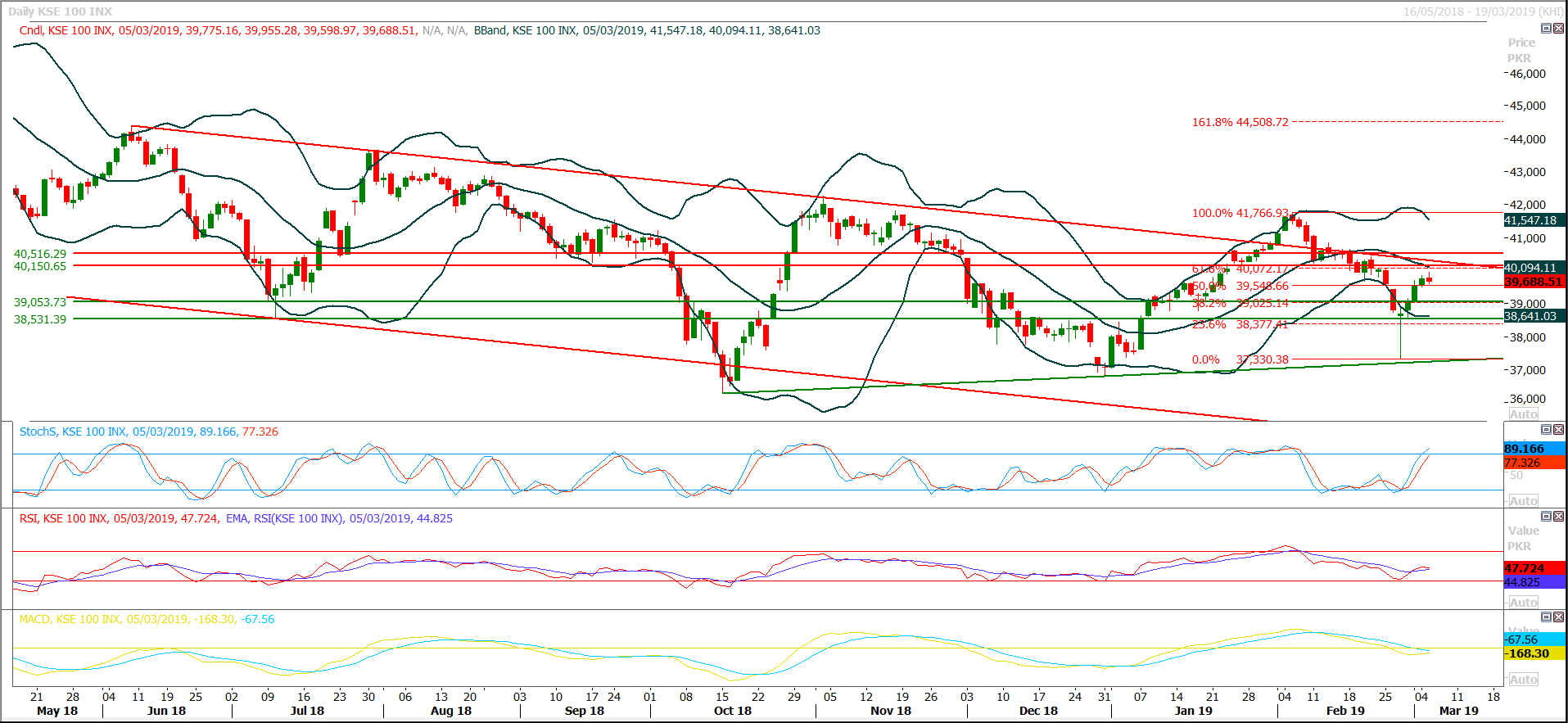
The Benchmark KSE100 Index have not succeeded in penetration of above its 61.8% correction during last trading session and now it would try to find support at 39,500 and 39,350 points during current trading session. It’s expected that index would try to recover after a dip during current trading session and it would succeeded in finding some ground at its respective supportive regions but it’s also recommended to post strict stop loss on long positions because if it would not sustain above 39,350 points then a serious downward rally would be witnessed in coming days. For current trading session index would face resistances at 39,860 and 40,150 points respectively and closing above 40,150 would call for 40,500 points where some extraordinary volumes would required maintaining above that region for further advance move.
 To Open picture in original resolution right click image and then click open image in a new tab
0 Comments
No comments yet. Be the first to comment!
Please log in to leave a comment.