
Previous Session Recap
Trading volume at PSX floor dropped by 32.10 million shares or 10.77% on DoD basis, whereas the benchmark KSE100 index opened at 35,653.33, posted a day high of 35,834.24 and a day low of 35,458.10 points during last trading session while session suspended at 35,758.52 points with net change of 105.19 points and net trading volume of 134.37 million shares. Daily trading volume of KSE100 listed companies dropped by 60.00 million shares or 30.87% on DoD basis.
Foreign Investors remained in net selling positions of 1.55 million shares but net value of Foreign Inflow increased by 3.16 million US Dollars. Categorically, Foreign Individuals and Foreign Corporate investors remained in net selling positions of 0.43 and 1.14 million shares but Overseas Pakistanis investors remained in net buying positions of 0.02 million shares. While on the other side Local Individuals, Brokers and Insurance Companies remained in net buying positions of 4.82, 0.56 and 1.88 million shares respectively but Local Companies, Banks, NBFCs and Mutual Fund remained in net selling positions of 2.74, 0.08, 0.42 and 1.20 million shares respectively.
Analytical Review
Global stocks close in on record highs on U.S.-China trade deal hopes
World stocks rallied to near record highs on Friday after China said it had agreed with the United States to cancel tariffs in phases, a key demand of Beijing for sealing a deal to end a trade war that has slowed economic growth and roiled markets. MSCI’s gauge of stocks across the globe rose slightly to stand at 543.70, just a hair off the record high of 550.63 reached in January 2018. The index compiler’s gauge of Asia-Pacific shares outside Japan edged up 0.2% in early trade while Tokyo’s Nikkei jumped 0.75% to a 13-month high. China and the United States have agreed to roll back tariffs on each others’ goods as part of the first phase of a trade deal, officials from both sides said on Thursday, in further signs of progress even as both side continue to haggle over several contentious issues. “As the U.S.-China dispute seems to be heading for a resolution while the developed world is adopting very easy monetary policy, risk assets are enjoying the tail wind,” said Masahiro Ichikawa, senior strategist at Sumitomo Mitsui DS Asset Management.
No relaxation, no waivers as IMF concludes review
Concluding the first quarterly review on a successful note, the International Monetary Fund (IMF) has asked the government to definitely achieve the revenue target, keep a cap on issuing new guarantees and put into effective implementation the circular debt reduction strategy. “The talks with the visiting mission have been highly successful,” a senior government official told Dawn adding the “government did not ask for a waiver, it was not required.” IMF’s country representative in Islamabad Teresa Daban Sanchez declined to comment when approached. According to the official, the mission also appreciated State Bank’s policy direction and wanted its continuation in the short- to medium-term period. On top of that, it wanted the government to play a more proactive role in ensuring independence of the central bank through legal instruments. Responding to a question, he said IMF called upon the government to avoid any tax exemptions and take decisive steps towards ‘harmonisation of taxes and removal of distortions’ at federal and provincial levels. He said neither the tax target was revised nor waivers sought or required.
Country may remain on FATF list beyond February: minister
Pakistan may remain on the grey list of the Financial Action Task Force (FATF) beyond February 2020, mainly because of its risk profile and in view of two simultaneous evaluations. Senior officials provided this information to a parliamentary panel on Thursday. They also revealed that the government recovered only Rs5.6 billion in taxes on foreign assets worth about $7.4bn (Rs1.15 trillion) of Pakistanis reported by the international community under information exchange arrangements. “Pakistan faces greater challenges than many other countries because of its risk profile,” said the minister responsible for economic affairs division, Hammad Azhar, while speaking at a meeting of the National Assembly’s Standing Committee on Finance and Revenue, presided over by MNA Asad Umar. He said that some countries had been removed from the grey list after just 80 per cent compliance while Pakistan was being pressurised to ensure 100pc compliance with the action plan.
Rs2bn relief package may be approved today
Prime Minister Imran Khan on Thursday asked top officials of the Utility Stores Corporation (USC) to devise a relief package worth approximately Rs2 billion for selling five essential food items on discount across the country, Dawn has learnt from official sources. The five products — rice, flour, pulses, sugar and edible oil — will be available at 4,000 USC outlets throughout the country. Presiding over a meeting with his economic team to discuss ways for controlling the prices of essential commodities, the prime minister asked USC officials to work out details of the package by Friday (today). The visibly disturbed premier held two consecutive meetings on the issue in two days. “The package is expected to be approved at a meeting on Friday,” a source told Dawn.
Post-harvest crop losses cost Pakistan over $1bn yearly: ADB
Pakistan could save about $1.13 billion annually by reducing up to 75 per cent of the current post-harvest losses, according to estimates mentioned in a paper on agricultural wholesale markets in Pakistan, released by the Asian Development Bank. The annual value of post-harvest losses of potato, tomato, peas, cauliflowers, carrots, turnips, radish, brinjal, squash, okra, onion, grapes and mango in Balochistan, Khyber-Pakhtunkhwa, Punjab and Sindh, valued at the respective 2016 provincial wholesale prices, is about $700 million to $934m. Discussing the case of Pakistan in a country market brief, titled ‘Dysfunctional Horticulture Value Chains and the Need for Modern Marketing Infrastructure’, the Rural Development and Food Security (Agriculture) Section of ADB, led by Akmal Siddiq, suggests that post-harvest losses in fruits and vegetables due to mishandling of the perishable product, poor transportation, and inadequate storage facilities and market infrastructure account for about 30 to 40pc of total production.
World stocks rallied to near record highs on Friday after China said it had agreed with the United States to cancel tariffs in phases, a key demand of Beijing for sealing a deal to end a trade war that has slowed economic growth and roiled markets. MSCI’s gauge of stocks across the globe rose slightly to stand at 543.70, just a hair off the record high of 550.63 reached in January 2018. The index compiler’s gauge of Asia-Pacific shares outside Japan edged up 0.2% in early trade while Tokyo’s Nikkei jumped 0.75% to a 13-month high. China and the United States have agreed to roll back tariffs on each others’ goods as part of the first phase of a trade deal, officials from both sides said on Thursday, in further signs of progress even as both side continue to haggle over several contentious issues. “As the U.S.-China dispute seems to be heading for a resolution while the developed world is adopting very easy monetary policy, risk assets are enjoying the tail wind,” said Masahiro Ichikawa, senior strategist at Sumitomo Mitsui DS Asset Management.
Concluding the first quarterly review on a successful note, the International Monetary Fund (IMF) has asked the government to definitely achieve the revenue target, keep a cap on issuing new guarantees and put into effective implementation the circular debt reduction strategy. “The talks with the visiting mission have been highly successful,” a senior government official told Dawn adding the “government did not ask for a waiver, it was not required.” IMF’s country representative in Islamabad Teresa Daban Sanchez declined to comment when approached. According to the official, the mission also appreciated State Bank’s policy direction and wanted its continuation in the short- to medium-term period. On top of that, it wanted the government to play a more proactive role in ensuring independence of the central bank through legal instruments. Responding to a question, he said IMF called upon the government to avoid any tax exemptions and take decisive steps towards ‘harmonisation of taxes and removal of distortions’ at federal and provincial levels. He said neither the tax target was revised nor waivers sought or required.
Pakistan may remain on the grey list of the Financial Action Task Force (FATF) beyond February 2020, mainly because of its risk profile and in view of two simultaneous evaluations. Senior officials provided this information to a parliamentary panel on Thursday. They also revealed that the government recovered only Rs5.6 billion in taxes on foreign assets worth about $7.4bn (Rs1.15 trillion) of Pakistanis reported by the international community under information exchange arrangements. “Pakistan faces greater challenges than many other countries because of its risk profile,” said the minister responsible for economic affairs division, Hammad Azhar, while speaking at a meeting of the National Assembly’s Standing Committee on Finance and Revenue, presided over by MNA Asad Umar. He said that some countries had been removed from the grey list after just 80 per cent compliance while Pakistan was being pressurised to ensure 100pc compliance with the action plan.
Prime Minister Imran Khan on Thursday asked top officials of the Utility Stores Corporation (USC) to devise a relief package worth approximately Rs2 billion for selling five essential food items on discount across the country, Dawn has learnt from official sources. The five products — rice, flour, pulses, sugar and edible oil — will be available at 4,000 USC outlets throughout the country. Presiding over a meeting with his economic team to discuss ways for controlling the prices of essential commodities, the prime minister asked USC officials to work out details of the package by Friday (today). The visibly disturbed premier held two consecutive meetings on the issue in two days. “The package is expected to be approved at a meeting on Friday,” a source told Dawn.
Pakistan could save about $1.13 billion annually by reducing up to 75 per cent of the current post-harvest losses, according to estimates mentioned in a paper on agricultural wholesale markets in Pakistan, released by the Asian Development Bank. The annual value of post-harvest losses of potato, tomato, peas, cauliflowers, carrots, turnips, radish, brinjal, squash, okra, onion, grapes and mango in Balochistan, Khyber-Pakhtunkhwa, Punjab and Sindh, valued at the respective 2016 provincial wholesale prices, is about $700 million to $934m. Discussing the case of Pakistan in a country market brief, titled ‘Dysfunctional Horticulture Value Chains and the Need for Modern Marketing Infrastructure’, the Rural Development and Food Security (Agriculture) Section of ADB, led by Akmal Siddiq, suggests that post-harvest losses in fruits and vegetables due to mishandling of the perishable product, poor transportation, and inadequate storage facilities and market infrastructure account for about 30 to 40pc of total production.
Market is expected to remain volatile during current trading session.
Technical Analysis
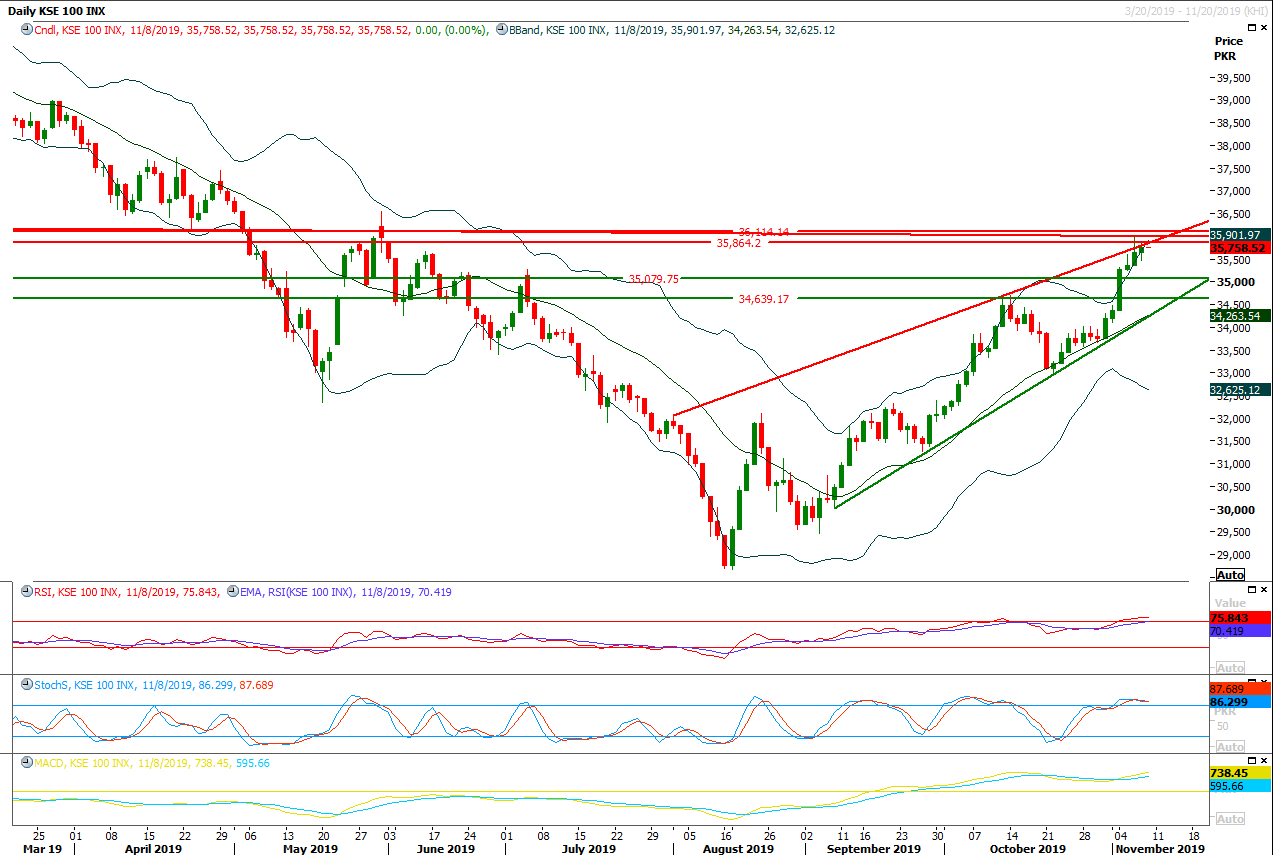
The Benchmark KSE100 index is being capped by a horizontal resistant region along with an ascending trend line at 36,000 and 36,200 points and it's expected that current bullish sentiment would start expiring around 36,200-36,700 points. It's recommended to post trailing stop loss on existing long positions and start selling on strength with strict stop loss of 36,700 points. Because if index would not succeed in breakout of 36,200 points then it would roll back to retest its supportive region at 34,500 points. On short term basis index would remain range bound between 34,500 to 36,700 points.
 To Open picture in original resolution right click image and then click open image in a new tab
0 Comments
No comments yet. Be the first to comment!
Please log in to leave a comment.