
Previous Session Recap
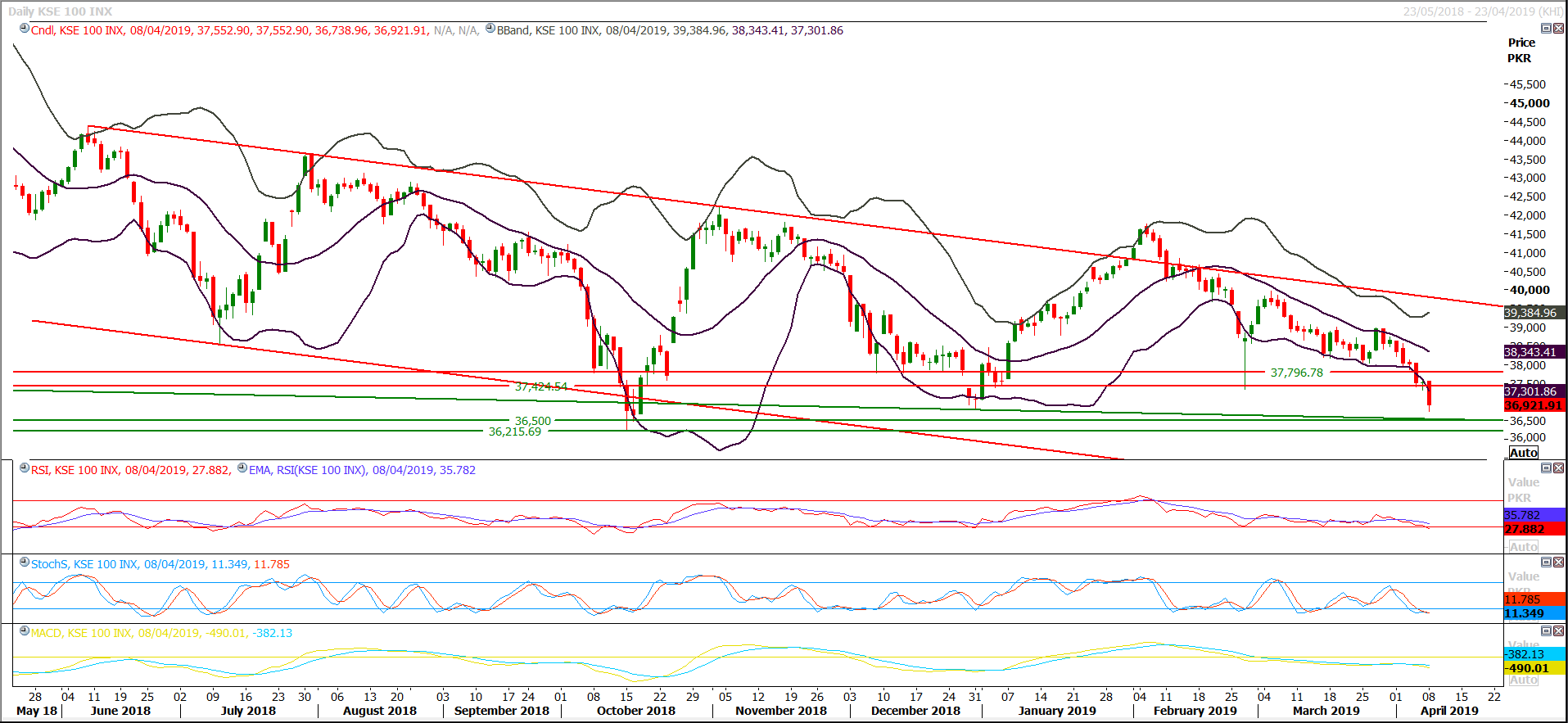
Trading volume at PSX floor increased by 5.23 million shares or 5.14% on DoD basis, whereas the benchmark KSE100 index opened at 37,552.90, posted a day high of 37,552.90 and a day low of 36,738.90 points during last trading session while session suspended at 36,921.91 with net change of -599.9 points and net trading volume of 73.33million shares. Daily trading volume of KSE100 listed companies increased by 25.26 million shares or 52.55% on DoD basis.
Foreign Investors remained in net buying positions of 2.90 million shares and net value of foreign inflow increased by 2.23 US Dollars. Categorically, Foreign Individuals and remained in net selling positions of 0.19 million shares but Foreign Corporate and Overseas Pakistanis investors remained in net buying positions of 1.12 and 1.97 million shares. While on the other side Local Individuals, Banks, NBFCs and Mutual Fund remained in net buying positions of 2.33, 3.11, 0.14 and 0.20 million shares respectively but Local Companies, Brokers and Insurance Companies remained in net selling positions of 3.92, 1.90 and 4.00 million shares respectively.
Analytical Review
Asia shares weighed by cautious mood, oil settles
Asian shares struggled to make gains on Tuesday as investors braced for key events later in the week, including the start of the U.S. earnings season and a crucial Brexit summit, while broader concerns about slowing global growth checked sentiment. MSCI’s broadest index of Asia-Pacific shares outside Japan was basically flat after brushing its highest since late August last year during the previous session. Japan’s Nikkei dipped 0.15 percent, while Australian shares and Chinese blue chips held steady. E-Mini futures for the S&P 500 lost 0.15 percent. Wall Street shares delivered a mixed performance on Monday, with the Dow Jones Industrial Average losing 0.3 percent while the S&P 500 added 0.1 percent. Concerns over slowing U.S. earnings have undermined U.S. equities in recent sessions, though a strong jobs report last week helped to soothe frayed nerves.
FEC releases of PSDP reach 121pc of total allocation
The releases of Foreign Exchange Component (FEC) of the Public Sector Development Programme (PSDP) have reached to 121 percent of the total allocation while releases against rupee component are 52 percent of PSDP allocation. Out of the total PSDP releases of Rs 449.26 billion, a 66.55 percent of Rs 675 billion, the share of rupees component is Rs 274.704 billion (51.76 percent) while the Foreign Aid component were Rs 174.56 billion (121 percent), said an official documents.
PBS decides to rebase CPI
The Pakistan Bureau of Statistics (PBS) has decided to re-base the Consumer Price Index (CPI) from fiscal year 2007-08 to fiscal 2015-16. The decision was taken in the 17th Meeting of the Governing Council of Pakistan Bureau of Statistics which met with Federal Minister for Planning, Development & Reform Makhdum Khusro Bakhtyar in the chair. The federal minister for planning is also the chairman of the Governing Council. The governing council approved the proposal of rebasing the Consumer Price Index (CPI) from FY 2007-08 to FY 2015-16. The rebasing was long overdue and the exercise was completed in December 2017 and Technical Committee has cleared it for presentation in the Council. Secretary Planning Zafar Hasan, members Governing Council and senior officials of the ministry were also present.
ECC seeks recommendations for PSM revival
The Economic Coordination Committee of the Cabinet on Monday directed the ministries concerned to submit formal recommendations for the revival of Pakistan Steel Mills (ECC) in the form of summary so that the ECC could make a final decision. A meeting of the Economic Coordination Committee of the Cabinet (ECC) was held yesterday under Finance Minister Asad Umar in the chair. The Revival Committee on Pakistan Steel Mills (PSM) gave a comprehensive presentation to the ECC for making the mills operational. The revival committee proposed various recommendations to make it a profitable and competitive organisation.
Asad Umar brushes aside critics, says painful measures will bear fruit
Finance Minister Asad Umar on Monday took a swipe at critics who accuse the government of having destabilised the economy with the weakening in the rupee-dollar exchange rate, saying the criticism was unfounded. "The exchange rate is not a measure of a strong economy. At one point, the Pakistani rupee was stronger than the Japanese yen, even though the latter's per capita income was much higher than ours," he explained. He also expressed his frustration with television anchors who have been critical of his policies, suggesting that business reporters — "who have a much better understanding of the technicalities of the economy" — sit with anchors and share their knowledge on how to report on economic matters.
Asian shares struggled to make gains on Tuesday as investors braced for key events later in the week, including the start of the U.S. earnings season and a crucial Brexit summit, while broader concerns about slowing global growth checked sentiment. MSCI’s broadest index of Asia-Pacific shares outside Japan was basically flat after brushing its highest since late August last year during the previous session. Japan’s Nikkei dipped 0.15 percent, while Australian shares and Chinese blue chips held steady. E-Mini futures for the S&P 500 lost 0.15 percent. Wall Street shares delivered a mixed performance on Monday, with the Dow Jones Industrial Average losing 0.3 percent while the S&P 500 added 0.1 percent. Concerns over slowing U.S. earnings have undermined U.S. equities in recent sessions, though a strong jobs report last week helped to soothe frayed nerves.
The releases of Foreign Exchange Component (FEC) of the Public Sector Development Programme (PSDP) have reached to 121 percent of the total allocation while releases against rupee component are 52 percent of PSDP allocation. Out of the total PSDP releases of Rs 449.26 billion, a 66.55 percent of Rs 675 billion, the share of rupees component is Rs 274.704 billion (51.76 percent) while the Foreign Aid component were Rs 174.56 billion (121 percent), said an official documents.
The Pakistan Bureau of Statistics (PBS) has decided to re-base the Consumer Price Index (CPI) from fiscal year 2007-08 to fiscal 2015-16. The decision was taken in the 17th Meeting of the Governing Council of Pakistan Bureau of Statistics which met with Federal Minister for Planning, Development & Reform Makhdum Khusro Bakhtyar in the chair. The federal minister for planning is also the chairman of the Governing Council. The governing council approved the proposal of rebasing the Consumer Price Index (CPI) from FY 2007-08 to FY 2015-16. The rebasing was long overdue and the exercise was completed in December 2017 and Technical Committee has cleared it for presentation in the Council. Secretary Planning Zafar Hasan, members Governing Council and senior officials of the ministry were also present.
The Economic Coordination Committee of the Cabinet on Monday directed the ministries concerned to submit formal recommendations for the revival of Pakistan Steel Mills (ECC) in the form of summary so that the ECC could make a final decision. A meeting of the Economic Coordination Committee of the Cabinet (ECC) was held yesterday under Finance Minister Asad Umar in the chair. The Revival Committee on Pakistan Steel Mills (PSM) gave a comprehensive presentation to the ECC for making the mills operational. The revival committee proposed various recommendations to make it a profitable and competitive organisation.
Finance Minister Asad Umar on Monday took a swipe at critics who accuse the government of having destabilised the economy with the weakening in the rupee-dollar exchange rate, saying the criticism was unfounded. "The exchange rate is not a measure of a strong economy. At one point, the Pakistani rupee was stronger than the Japanese yen, even though the latter's per capita income was much higher than ours," he explained. He also expressed his frustration with television anchors who have been critical of his policies, suggesting that business reporters — "who have a much better understanding of the technicalities of the economy" — sit with anchors and share their knowledge on how to report on economic matters.
Market is expected to remain volatile during current trading session therefore it's recommended to stay cautious while trading
Technical Analysis
The Benchmark KSE100 would try to find support at its previous bottom where a horizontal supportive region & a supportive trend line fall on 36,500 points and it’s expected that index would try to take an intraday spike initially but it’s recommended to stay cautious before initiating new long positions until index close above 37,500 points on daily chart. It’s highly expected that index would try penetrate its previous low before bouncing back in coming days therefore it’s recommended to start buying in chunks till index find some ground around 35,800 points. While on flipside index would face resistances at 37,500 & 37,800 points in case of reversal and would remain bearish until unless it would succeed in closing above these both levels. Both daily & weekly momentum indicators are in bearish mode but only hourly momentum have reached oversold region and to normalize it index would try to take an intraday spike and then would continue its bearish rally which may lead index towards 36,500 & 36,000 points and if it would succeed in sliding below 35,800 points then next targets would be 35,120 & 34,600 points.
 To Open picture in original resolution right click image and then click open image in a new tab
0 Comments
No comments yet. Be the first to comment!
Please log in to leave a comment.